In the aerospace industry, where safety, performance, and reliability are non-negotiable, every component must meet exacting standards. A single imperfection in a turbine shaft, bracket, fastener, or structural fitting can have serious consequences. That’s why precision CNC turning has become a cornerstone of modern aerospace manufacturing and why companies like Sotek Engineering rely on it to deliver mission-critical parts to the highest specifications.
But what exactly makes CNC turning stand out for aerospace precision? Let’s explore the key ways this process delivers unmatched accuracy, consistency, and efficiency.
1. Superior Accuracy and Tight Tolerances
Aerospace components often require tolerances as tight as ±0.005 mm (or even finer in high-performance applications). CNC turning excels here because the workpiece rotates while a stationary cutting tool removes material with computer-controlled precision.
At Sotek Engineering, our CNC turning capabilities allow us to achieve these exacting tolerances consistently, even on complex cylindrical or rotational parts like shafts, bushings, and fittings. The automated nature of CNC eliminates human error common in manual machining, ensuring every part meets the strict requirements of aerospace clients, whether for commercial aircraft, defence systems, or space applications.
2. Repeatability for High-Volume and Prototype Production
Aerospace projects frequently involve both one-off prototypes (for testing new designs) and higher-volume production runs (for aircraft fleets or defence contracts). CNC turning shines in both scenarios thanks to its programmable repeatability.
Once a program is verified, the same setup can produce hundreds or thousands of identical parts with virtually no variation. This is critical in aerospace, where traceability and consistency are audited rigorously. Sotek’s advanced CNC lathes support this by maintaining precision across batches, helping clients reduce rework, scrap, and costly delays.
3. Ability to Handle Complex Geometries and Features
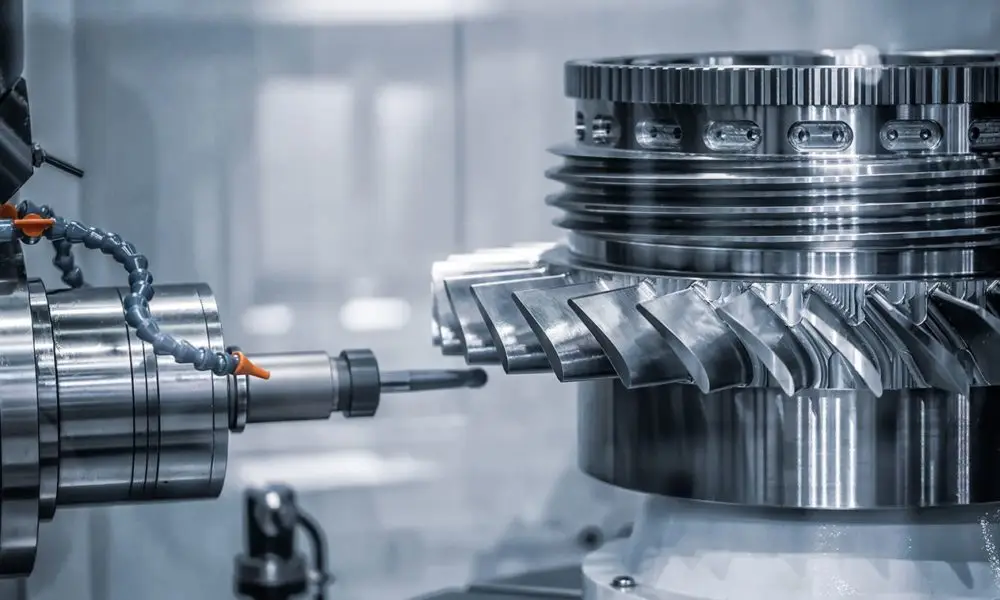
Many aerospace parts aren’t simple cylinders, they include grooves, threads, tapers, undercuts, and intricate profiles. Modern CNC turning centres (often with live tooling, multi-axis capabilities, and Y-axis options) can incorporate milling, drilling, and other operations in a single setup.
This “done-in-one” approach minimises handling errors and improves overall precision. For aerospace clients, it means faster turnaround on parts like engine components, landing gear elements, or hydraulic fittings, without sacrificing the tight tolerances demanded by the sector.
4. Material Versatility for Demanding Aerospace Alloys
Aerospace relies on high-performance materials such as titanium, Inconel, stainless steels, aluminium alloys, and specialist composites. These materials are tough, heat-resistant, and often difficult to machine conventionally.
CNC turning handles them effectively with optimised toolpaths, speeds, feeds, and coolant strategies to prevent distortion, work hardening, or surface defects. Sotek Engineering’s experience across aerospace, defence, and related high-tech sectors ensures we select the right approaches to maintain surface finishes and dimensional stability on even the most challenging alloys.
5. Enhanced Efficiency and Cost-Effectiveness
Precision isn’t just about accuracy, it’s also about delivering parts on time and within budget. CNC turning reduces cycle times compared to traditional methods, especially for rotational parts. Features like automatic tool changers, bar feeders for unattended running, and quick setup changes further boost efficiency.
For aerospace manufacturers facing tight deadlines and supply chain pressures, partnering with a reliable subcontract provider like Sotek means accessing precision CNC turning without the overhead of in-house equipment. This helps keep projects moving while maintaining the uncompromising quality the industry expects.
Why Choose Sotek Engineering for Your Aerospace CNC Turning Needs?
Since 2017, Sotek Engineering has built a reputation for for delivering high-precision, reliable CNC-turned components to demanding industries such as aerospace and defence, combining advanced machining technology with expert engineering knowledge to ensure every part meets the strictest quality and performance standards.